
You cannot legally pump out a portable toilet yourself near Washington DC—only licensed septage haulers with EPA and state certifications can perform this regulated service. Maryland, Virginia, and DC require proper permits, waste manifests, and DOT-certified equipment to safely extract and transport waste to approved treatment facilities. DIY pumping risks EPA fines exceeding $50,000, pathogen exposure, and environmental violations. Professional services cost $75-$150 per call and guarantee full compliance with health codes. Understanding the complete pumping process and regulatory requirements will help you make informed decisions about portable toilet maintenance.
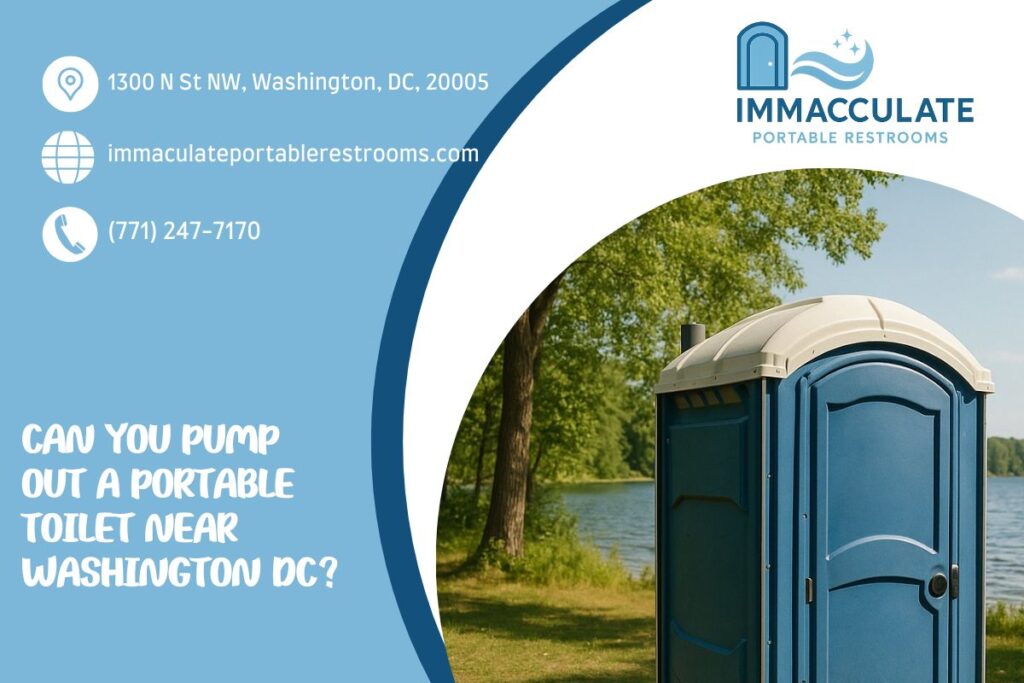
The pumping process begins when a vacuum truck equipped with a specialized waste extraction system arrives at your location.
Our certified technician connects a heavy-duty suction hose to the unit’s waste-holding-tank access point. The truck’s powerful vacuum pump creates negative pressure, extracting all waste materials and liquids into the vehicle’s sealed containment tank.
Throughout the extraction, the technician monitors seal integrity to prevent spills and ensures compliance with EPA regulations.
Once pumping’s complete, we flush the tank with sanitizing solution and deodorizing agents. The waste is then transported to an approved treatment facility, where it’s processed in accordance with local wastewater management standards.
This systematic approach protects public health while maintaining environmental safety protocols required by Washington DC’s Department of Energy and Environment.
See also: Washington portable toilet rental service
Beyond waste extraction, our comprehensive servicing protocol includes multiple sanitation stages to maintain your site’s hygiene standards.
We’ll vacuum the holding tank using EPA-compliant equipment, then pressure-wash interior surfaces with antimicrobial solutions that eliminate pathogens and odor-causing bacteria. You’ll receive fresh deodorizing chemicals—typically formaldehyde-free blue or green additives—that comply with local wastewater regulations.
Our technicians replenish consumables, including toilet paper, hand sanitizer, and urinal blocks, while inspecting structural components for damage.
We’ll verify that door latches, ventilation systems, and waste level indicators function properly. Each unit receives exterior cleaning to maintain professional appearance standards.
The entire process takes 10-15 minutes per unit, minimizing disruption to your operations.
You’re guaranteed service documentation showing pump-out dates, waste volumes, and disposal facility receipts—critical records for construction site audits and environmental compliance reporting.
Industrial-grade vacuum trucks form the backbone of compliant portable restroom waste extraction, equipped with DOT-certified holding tanks ranging from 1,500 to 3,000 gallons.
You’ll find that these specialized vehicles feature powerful vacuum pumps that generate up to 28 inches of mercury, enabling complete waste removal from holding tanks. The equipment includes food-grade discharge hoses with sealed couplings that prevent environmental contamination during pumping.
Safety mechanisms you can expect include emergency shutoff valves, spill-containment systems, and pressure-relief features that protect both operators and your property.
Modern trucks incorporate GPS tracking and digital waste monitoring systems, ensuring regulatory compliance with EPA guidelines. Your service provider should maintain equipment that meets all local health department specifications, ensuring safe, efficient waste extraction with no environmental risk.
Only licensed septage haulers with proper state and federal certifications can legally pump portable toilet waste in the Washington DC metro area.
You can’t perform this service yourself—it requires specialized training, commercial vehicle permits, and compliance with EPA regulations governing septage disposal.
Licensed technicians must complete bloodborne pathogen training and understand proper containment protocols.
They’re required to transport waste to EPA-approved treatment facilities and maintain detailed manifests for regulatory tracking.
If you attempt unauthorized pumping, you’ll face significant fines from local health departments and environmental agencies.
The DC Department of Energy and Environment enforces strict penalties for improper waste handling.
At Immaculate Portable Restrooms, our certified technicians handle all pumping services, ensuring full regulatory compliance and protecting public health throughout the Washington, DC region.
Licensed sanitation professionals undergo rigorous certification programs that meet both Maryland and Virginia state requirements for septage handling. You’ll find that these technicians possess specialized knowledge in waste transport regulations, environmental protection protocols, and proper disposal procedures. They’re equipped with commercial-grade vacuum trucks that comply with EPA standards.
| Certification Component | Requirement |
|---|---|
| OSHA Safety Training | 40-hour hazardous waste operations |
| Commercial Driver’s License | Class B with tank endorsement |
| State Septage Permit | Annual renewal with background check |
| EPA Compliance Knowledge | Federal wastewater disposal regulations |
| Equipment Certification | Vacuum truck DOT inspection compliance |
When you contract with Immaculate Portable Restrooms, you’re ensuring that only certified professionals handle your waste removal, protecting public health and maintaining regulatory compliance throughout the pumping process.
While certified professionals bring necessary expertise to waste management, attempting to pump portable toilets yourself creates significant legal and health hazards. Washington, D.C., enforces strict regulations governing sewage disposal, and improper handling violates local health codes.
DIY pumping exposes you to serious risks:
You’ll lack the proper personal protective equipment, vacuum trucks, and waste-disposal permits required under DC Municipal Regulations.
Licensed operators maintain insurance coverage and adhere to established protocols to protect public health and environmental safety.
Under the District of Columbia Municipal Regulations (DCMR) Title 21, portable toilet waste must be transported and disposed of exclusively at licensed sewage treatment facilities.
You’re required to maintain proper manifests documenting waste volumes, pickup locations, and disposal sites. The DC Department of Energy and the Environment (DOEE) requires only certified waste haulers with valid permits to pump and transport portable toilet contents.
Violations carry fines up to $10,000 per incident. You must verify your service provider holds current liability insurance and complies with EPA standards for septage handling.
Maryland and Virginia jurisdictions surrounding DC enforce similar requirements through their respective environmental agencies. Non-compliance risks contaminating water sources and creating public health hazards.
Professional pumping services, such as Immaculate Portable Restrooms, maintain all required certifications and adhere to proper disposal protocols.
Because wastewater disposal regulations vary across jurisdictions, you’ll need to understand the specific requirements governing your location in the DC metropolitan area.
The District of Columbia, Maryland, and Virginia each maintain distinct frameworks for handling portable toilet waste.
Your compliance obligations include:
Maryland’s Department of the Environment, Virginia’s Department of Health, and DC Water each enforce specific pumping protocols.
You’re responsible for verifying that your service provider maintains current certifications and follows jurisdiction-specific disposal procedures.
Violations of wastewater disposal regulations carry significant financial and legal consequences that can threaten your business operations.
The District of Columbia Department of Energy & Environment (DOEE) imposes fines ranging from $2,500 to $25,000 per violation for illegal dumping of septage. You’ll face supplementary penalties if contamination affects water sources or public property.
Maryland and Virginia enforce similar sanctions, including permit revocations and criminal charges for repeat offenders. Non-compliance can result in mandatory cleanup costs that often substantially exceed initial fines.
Your company’s operating licenses may be suspended or permanently revoked following serious infractions.
Beyond monetary penalties, you’ll encounter increased regulatory scrutiny, mandatory environmental audits, and potential civil lawsuits from affected parties.
Criminal prosecution becomes possible when violations demonstrate willful negligence or environmental damage. Maintaining compliance protects your business reputation and operational continuity.
Standard portable toilets require pumping when waste levels reach 70-75% of the tank capacity, typically after 60-100 uses, depending on unit size and deployment duration.
You’ll need to schedule service more frequently during high-traffic events or extended rental periods to maintain sanitary conditions and prevent overflows.
Monitor these critical indicators that signal immediate pumping requirements:
Immaculate Portable Restrooms establishes customized pumping schedules based on your event size, duration, and expected usage patterns.
We’ll guarantee compliance with DC Department of Energy & Environment regulations while maintaining ideal sanitation standards throughout your rental period.
Operational issues signal tank saturation.
The toilet paper dispenser may become wet due to condensation from gases released by an overflowing tank.
You might observe slow drainage or complete backup when flushing.
Waste may accumulate on the seat or floor, posing biohazard exposure risks that require immediate professional pumping services to maintain compliance with DC health regulations.
Standard recommended intervals include:
You should increase pumping frequency during Washington DC’s humid summer months when decomposition accelerates and odor intensifies.
Monitor waste levels between scheduled service intervals, particularly at high-traffic locations.
Immaculate Portable Restrooms provides customized service schedules tailored to your site requirements and usage patterns.
After pumping removes waste from your portable toilet, licensed haulers transport the sewage to EPA-approved treatment facilities that comply with Washington DC’s stringent wastewater regulations.
| Stage | Purpose |
|---|---|
| Screening | Removes solid debris and non-biodegradable materials |
| Primary Treatment | Separates suspended solids through settling tanks |
| Alternate Treatment | Uses biological processes to break down organic matter |
| Disinfection | Eliminates harmful pathogens before discharge |
| Biosolids Management | Converts remaining sludge into fertilizer or disposes safely |
You’ll find these facilities continuously monitor discharge quality, ensuring that effluent meets Clean Water Act standards. DC Water and other regional plants maintain strict chain-of-custody documentation, tracking waste from collection through final disposal. This regulated system protects public health and environmental resources throughout the metropolitan area.
Throughout the Washington, DC, metropolitan area, portable toilet waste must be delivered exclusively to facilities holding valid National Pollutant Discharge Elimination System (NPDES) permits issued by the EPA or the DC Department of Energy & Environment (DOEE).
These regulated facilities employ advanced treatment processes to protect public health and regional waterways.
Licensed pumping operators maintain documentation proving proper disposal at authorized locations.
You’ll benefit from this regulatory framework that guarantees:
Immaculate Portable Restrooms exclusively uses EPA-approved disposal sites and maintains complete chain-of-custody records for every pump-out service we perform throughout the DC region.
When portable toilet waste enters regional water systems improperly, it introduces pathogens, pharmaceuticals, and nitrogen compounds that threaten the health of the Chesapeake Bay watershed and DC’s drinking water sources.
You’ll find that licensed pumping services, such as Immaculate Portable Restrooms, follow strict protocols to prevent environmental contamination. We transport waste exclusively to EPA-approved facilities where it undergoes biological treatment, pathogen removal, and nutrient reduction before discharge.
Your compliance with DC’s environmental regulations protects the Potomac and Anacostia rivers from fecal coliform bacteria and harmful chemicals.
Illegal dumping creates public health hazards and violates the Clean Water Act, resulting in substantial penalties. We maintain detailed manifests documenting waste quantities, treatment locations, and disposal methods.
These records ensure accountability throughout the handling process, safeguarding your watershed while meeting DOEE requirements for responsible waste management.
Beyond environmental compliance, portable toilet pumping exposes workers and nearby individuals to significant biological and chemical hazards.
You’re dealing with untreated human waste containing pathogens such as E. coli, Hepatitis A, and norovirus, which can cause severe illness through direct contact or aerosolization during pumping operations.
Professional pumping services must implement strict protocols:
OSHA regulations mandate these safety measures because improper handling creates exposure risks extending beyond the immediate work area.
That’s why you shouldn’t attempt DIY pumping—professional services maintain compliance while protecting public health.
While professional pumping crews wear protective equipment, exposure hazards extend to anyone within the contamination zone during service operations. You’ll face serious health risks if proper protocols aren’t followed during portable toilet pumping.
| Contamination Type | Health Risk |
|---|---|
| Bacterial pathogens | Gastrointestinal infections, E. coli exposure |
| Bloodborne pathogens | Hepatitis A, B transmission potential |
| Airborne particulates | Respiratory complications, disease transmission |
OSHA regulations require containment procedures to minimize splash-back and aerosol generation during waste extraction. You must maintain a minimum three-foot perimeter around active pumping operations. Cross-contamination occurs through inadequate hose sanitization between units, contaminated surfaces, and improper waste handling. Professional services implement EPA-compliant decontamination protocols to protect both workers and property owners from exposure to hazardous materials.
Professional pumping operations require a comprehensive PPE protocol that complies with OSHA 29 CFR 1910.132 for bloodborne pathogen exposure.
You’ll need extensive protection during pumping procedures to prevent contamination incidents.
Essential protective equipment includes:
You must guarantee proper donning and doffing sequences to prevent cross-contamination.
Gloves require double-layering for puncture protection, and all PPE must be disposed of or decontaminated immediately after each pumping operation.
Washington DC’s Department of Energy & Environment enforces strict compliance with these protocols.
Our technicians maintain current certifications and adhere to established safety procedures on every service call.
Frequency impacts your total costs—high-traffic events need more frequent service than construction sites.
DC’s regulatory compliance requirements may require certified waste-disposal documentation, potentially increasing fees. You should factor in seasonal pricing fluctuations, as peak demand periods command premium rates.
Distance from the service provider’s facility affects fuel surcharges and travel time costs.
Request detailed quotes specifying all fees to avoid unexpected expenses.
Standard portable toilet pumping rates in the Washington DC metropolitan area range from $75 to $150 per service call, depending on waste volume and unit accessibility.
You’ll find pricing varies based on your specific requirements and service frequency.
Several factors influence your final cost:
You should request detailed quotes that specify waste disposal methods, compliance certifications, and safety protocols.
We at Immaculate Portable Restrooms provide transparent pricing that includes proper septage handling, required permits, and compliance with DC Water and Sewer Authority regulations to protect public health.
When you’re evaluating portable toilet pumping expenses, geographic accessibility directly impacts your service costs. Remote locations or sites with restricted vehicle access require specialized equipment and extra labor, increasing your expenses.
The unit’s waste capacity determines pump-out frequency: standard units hold 60 gallons, while high-capacity models hold 300+ gallons, which affects service intervals and costs.
Your site’s usage intensity influences pumping requirements. Construction sites with 15+ workers need more frequent service than weekend events.
Compliance with Washington DC’s waste disposal regulations mandates proper treatment facility routing, which affects pricing based on distance. Emergency or after-hours service requests carry premium rates.
Seasonal demand fluctuations, particularly during spring construction and summer festivals, impact availability and pricing. Contract terms offering scheduled service typically provide cost advantages over one-time pump-outs.
While self-pumping portable toilets might seem cost-effective, you’ll face significant regulatory and safety barriers that make professional service the only viable option.
Licensed pumping services guarantee compliance with DC’s wastewater regulations and proper disposal at approved treatment facilities.
Professional alternatives include:
These services use vacuum trucks equipped with proper containment systems and PPE.
Licensed operators understand local ordinances governing waste transport and disposal, protecting you from potential violations and environmental hazards associated with improper handling.
Professional pumping schedules depend on three critical variables: unit capacity, user volume, and event duration.
Standard units require servicing when they reach 75% capacity to prevent overflow incidents and maintain sanitary conditions. You’ll need more frequent service for high-traffic events—typically every 2-3 days for construction sites with 10+ workers, or daily for large gatherings exceeding 100 attendees.
Washington DC’s Department of Energy and Environment mandates proper waste disposal from portable sanitation units. You must coordinate with licensed waste haulers who comply with local regulations.
At Immaculate Portable Restrooms, we’ll assess your specific requirements and establish a maintenance schedule that prevents capacity issues. Don’t wait until you’ve got complaints—proactive scheduling guarantees compliance and protects public health while avoiding costly emergency service calls.
As user demand fluctuates throughout your project or event, you’ll need supplemental units to maintain the required ratio of one toilet per 10 workers for construction sites, or one unit per 50 attendees for special events—standards established by OSHA and DC Health Department guidelines.
Immaculate Portable Restrooms provides scalable rental solutions when pumping existing units isn’t sufficient:
We’ll assess your current setup, calculate deficiencies based on occupancy projections, and deliver properly serviced units within 24 hours.
Our fleet includes standard porta-potties, deluxe restrooms, and handicap-accessible facilities, ensuring regulatory compliance across all Washington, DC job sites and events.
Yes, you can pump portable toilets during Washington DC winters. However, you’ll need antifreeze additives in holding tanks to prevent freezing, and technicians must follow cold-weather safety protocols. We recommend increasing service frequency during extreme temperature conditions to ensure optimal compliance with sanitation standards.
Yes, we provide emergency portable toilet service on weekends and holidays throughout the Washington, DC, area. You’ll receive the same compliant waste removal and sanitation standards we maintain during regular business hours, ensuring continuous regulatory adherence.
You’ll find that pumping out a portable toilet typically takes 10-15 minutes when you’re following proper waste-handling protocols. We’ll guarantee compliance with DC sanitation regulations while maintaining safety standards throughout the service process.
Yes, you can rent portable toilets with integrated hand washing stations. We offer ADA-compliant units featuring hand sanitizer dispensers and handwashing sinks that meet health department regulations, ensuring proper hygiene protocols are maintained at your DC-area site.
Yes, you’ll receive discounted rates for long-term portable toilet rentals. We offer cost-effective pricing structures for extended contracts, ensuring compliance with sanitation regulations while meeting your project’s duration requirements. Contact us to discuss your specific timeline and obtain customized pricing.

© 2026 Immaculate Portable Restrooms. All Rights Reserved.