
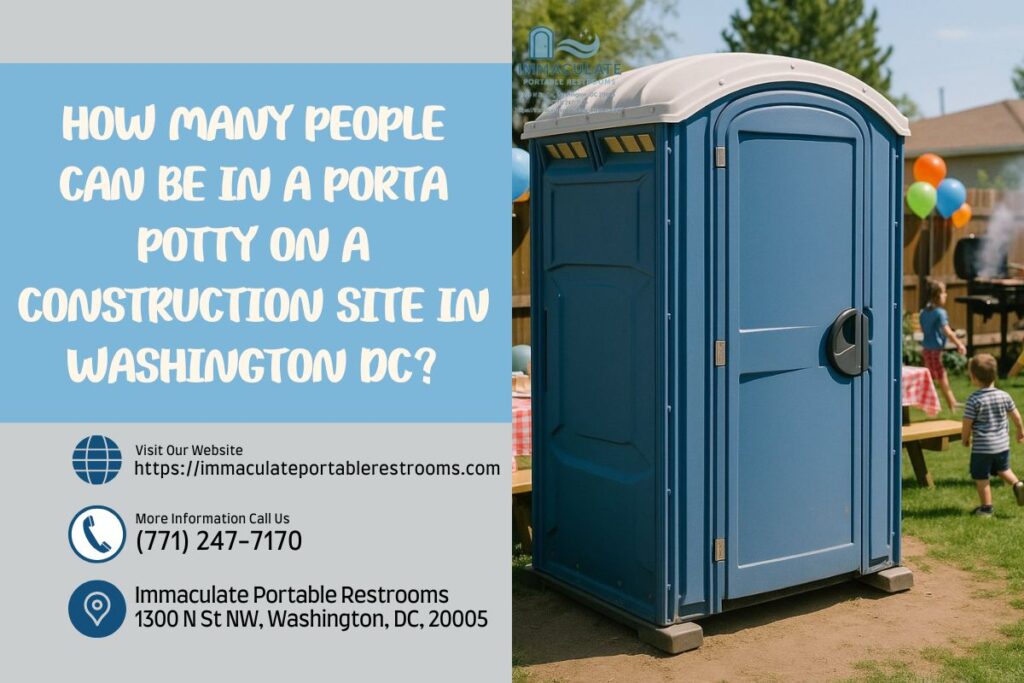
Porta-potties on Washington, D.C. construction sites are designed for single-person occupancy only—you can’t legally have more than one person inside at a time. OSHA and local regulations strictly enforce this safety standard, treating “capacity” as the number of workers one unit can serve (typically 10-20 per unit, depending on shift length), not as simultaneous occupancy. Violations risk penalties up to $15,625, and proper worker-to-toilet ratios guarantee compliance while maintaining productivity. The guidelines below clarify exactly how capacity calculations work for your specific project requirements.
When planning construction site sanitation, OSHA mandates one toilet facility for every 20 workers or a fraction thereof.
You’ll need to calculate your requirements based on peak workforce numbers, not average daily attendance. The regulation applies to shifts exceeding four hours when facilities are within a five-minute walk of work areas.
Standard single-occupancy units accommodate one person at a time, making the “how many people” question about ratio planning rather than simultaneous use.
You’re responsible for maintaining adequate capacity during shift changes when demand spikes. High-volume construction projects often deploy ADA-compliant units and hand-washing stations to meet accessibility requirements.
Smart contractors integrate IoT-enabled units that monitor usage patterns, optimizing service schedules and preventing compliance violations.
Your portable restroom strategy directly impacts worker productivity and regulatory adherence.
See also: construction site porta potty rental service near Washington
Unlike consumer products with weight or volume ratings, portable toilet capacity refers to three distinct metrics you must track: physical occupancy limits, waste tank volume, and recommended service intervals.
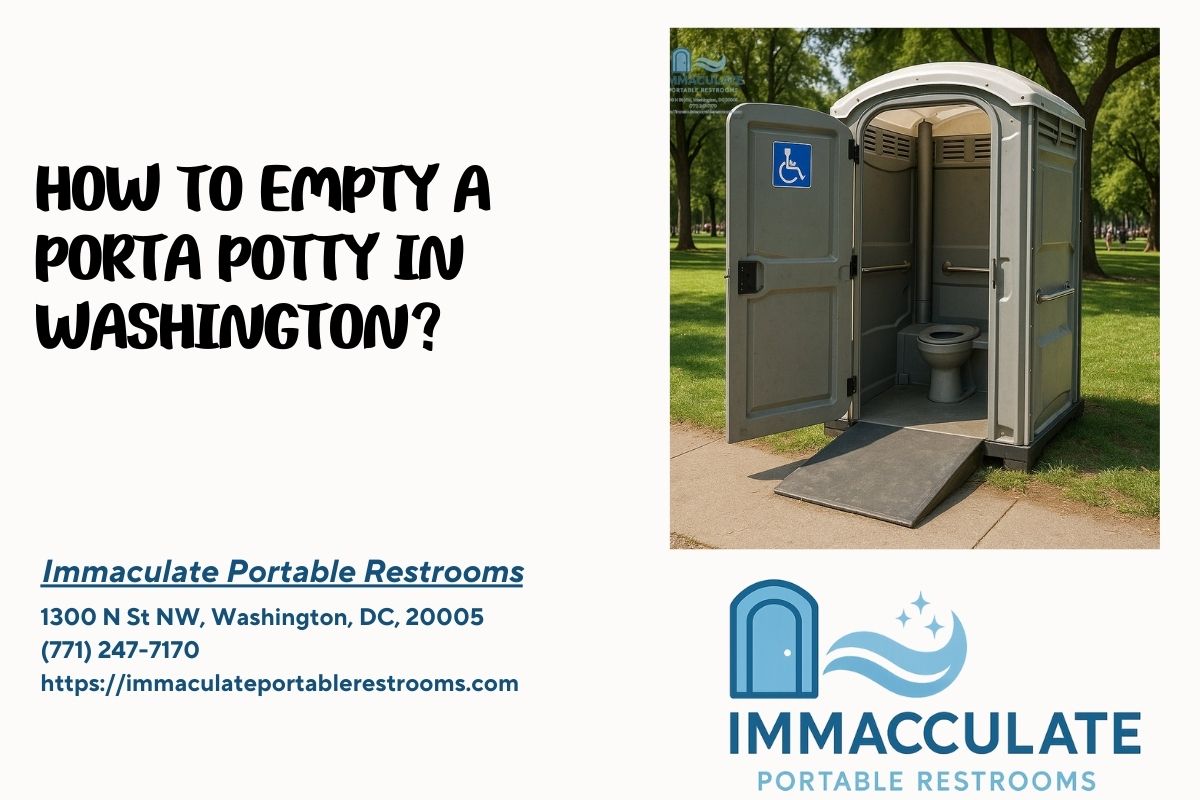
Physical occupancy determines how many workers can safely use the unit simultaneously—typically one person, though ADA-compliant units accommodate wheelchair users plus attendants.
Waste tank capacity measures your unit’s holding capacity, ranging from 60 to 70 gallons in standard models. This directly impacts:
Service intervals calculate the worker-to-unit ratio based on anticipated daily usage. You’ll need to balance waste accumulation rates against regulatory requirements and operational efficiency.
Washington, DC’s environmental regulations require proper waste management tracking to prevent overflow that violates municipal codes.
Standard porta-potty construction imposes strict limitations on both structural capacity and waste containment.
You’re dealing with holding tanks that typically accommodate 60-70 gallons of waste—sufficient for 200-300 individual uses under ideal conditions. The structural design prioritizes single-occupancy use, with flooring engineered to safely support approximately 250-300 pounds.
Washington DC’s Department of Consumer and Regulatory Affairs mandates that you maintain adequate facilities based on workforce size, not occupancy maximums. Your holding tank reaches capacity faster when you’re servicing high-traffic sites, requiring more frequent pump-outs to prevent overflow violations.
Modern sensor technology now enables real-time capacity monitoring, allowing you to schedule service proactively rather than reactively. Understanding these technical constraints helps you enhance your rental quantities and service intervals for compliance and operational efficiency.
OSHA’s 29 CFR 1926.51(c) requires that you provide one toilet seat and urinal for every 20 workers on construction sites, with facilities located within a 5-minute walk of work areas.
These baseline requirements guarantee compliance while minimizing productivity loss from extended facility access times.
Modern construction site planning demands attention to these critical factors:
Strategic placement and proper unit quantities reduce downtime, maintain regulatory compliance, and demonstrate your commitment to worker welfare.
Porta-potties accommodate only one person at a time—no exceptions. This regulation exists for structural integrity and safety compliance. OSHA standards explicitly prohibit multiple occupants, as these units aren’t engineered to support supplementary weight loads or simultaneous use.
Violating single-occupancy rules exposes you to liability and potential regulatory citations. The one-person mandate also addresses hygiene protocols and privacy requirements mandated by construction site regulations.
When you enforce this policy, you’re preventing structural damage to door mechanisms, ventilation systems, and base stability. Modern units incorporate occupancy indicators that signal when someone’s inside, streamlining traffic flow while maintaining compliance.
You should implement clear signage and worker orientation to reinforce these restrictions. Non-compliance compromises unit longevity and increases maintenance costs—factors that directly impact your project timeline and budget.
Industry benchmarks indicate that workers require restroom access approximately every 2-4 hours during standard shifts, though this varies with hydration levels, temperature, and workload intensity.
You’ll need to account for peak usage periods when calculating your portable restroom requirements for construction sites.
OSHA guidelines recommend sufficient facilities to prevent excessive wait times that could impact productivity and worker health.
Consider these frequency factors:
You should monitor wait times and adjust the number of porta-potties accordingly to maintain compliance and operational efficiency throughout your project.
When operating construction sites or events in Washington DC, you must comply with both federal OSHA standards and District-specific regulations governing portable sanitation facilities. OSHA mandates minimum toilet-to-worker ratios, while DC’s Department of Consumer and Regulatory Affairs enforces supplementary requirements for construction projects.
| Workers on Site | Minimum Toilets Required | Hand Washing Stations |
|---|---|---|
| 1-20 | 1 | 1 |
| 21-40 | 2 | 2 |
| 41-60 | 3 | 3 |
You’ll face penalties for non-compliance, including work stoppages and fines up to $15,625 per violation. DC requires permits for extended porta-potty placement on public property. Smart contractors use digital compliance-tracking systems to automatically monitor usage ratios, ensuring you’re always meeting regulatory thresholds while optimizing sanitation coverage across your project sites.
Under federal OSHA Standard 1926.51(c), construction site operators must provide adequate toilet facilities that meet specific numerical ratios based on workforce size.
You’ll need to comply with these minimum requirements:
You must ensure that facilities remain accessible within a reasonable walking distance and that sanitary conditions are maintained throughout your project.
OSHA doesn’t specify maximum occupancy per unit, but emphasizes adequate provision based on your workforce count.
Washington DC enforces these federal standards while incorporating local health department oversight.
You’re responsible for positioning units strategically across larger sites to meet accessibility requirements.
Non-compliance risks citations, penalties, and project delays that’ll impact your construction timeline.
Beyond federal OSHA requirements, you’ll navigate supplementary regulatory layers when operating construction sites in Washington DC. The District’s Department of Consumer and Regulatory Affairs (DCRA) enforces specific permit conditions that often exceed baseline federal standards.
You’re required to maintain detailed sanitation logs and demonstrate compliance during inspections, which can occur without advance notice.
Washington, DC’s Department of Energy and Environment (DOEE) adds environmental compliance requirements, particularly regarding waste-disposal documentation and treatment facility documentation. You’ll need proper manifests for tracking waste removal from your construction site.
Additionally, DC’s minimum ratio requirements may differ from federal guidelines during major projects or public works contracts.
Smart contractors integrate GPS-enabled restroom monitoring systems and automated service scheduling to guarantee continuous compliance across all regulatory jurisdictions while minimizing operational risk.
OSHA’s standard calculation establishes one portable toilet unit for every 10 workers during a standard 40-hour workweek.
However, you’ll need to adjust this ratio based on several variables that directly impact restroom demand and regulatory compliance.
Your actual requirements depend on:
For Washington DC projects, you should account for both federal OSHA standards and local ordinances.
Immaculate Portable Restrooms can help you calculate precise unit counts that prevent compliance gaps while optimizing site logistics and worker satisfaction.
Standard compliance calculations require one portable toilet for every ten workers on an eight-hour shift, but you’ll face significant regulatory violations if you apply this ratio without considering actual work patterns.
OSHA mandates adjustments for extended shifts—twelve-hour operations demand extra units to prevent wait-time violations and maintain sanitation standards. You’re operating in non-compliance if you’re calculating solely based on headcount, without factoring shift overlaps, peak usage periods, or crew rotations.
Modern workforce analytics reveal that staggered breaks and multi-shift operations require dynamic toilet deployment strategies.
Washington, DC’s strict building codes enforce these ratios rigorously, with inspectors increasingly focused on verifying adequate facilities during surprise site visits.
Your risk mitigation strategy should incorporate real-time occupancy tracking and predictive modeling to guarantee continuous compliance across fluctuating workforce densities.
When your workers exceed standard eight-hour shifts, you’re required to boost portable toilet availability proportionally—federal regulations don’t permit you to maintain baseline ratios during extended operations.
Calculate your improved sanitation needs using these shift-based multipliers:
OSHA enforcement targets inadequate sanitation during extended operations, creating compliance risk exposure.
Your Washington, DC projects with typical overtime schedules demand proactive capacity planning. Smart contractors integrate shift-length variables into initial rental calculations rather than reactively including units after violations occur.
Beyond shift duration, multiple operational variables directly impact your required portable toilet quantities and service frequencies. You’ll need to account for temperature extremes, which accelerate waste tank fill rates and increase worker hydration needs. Site accessibility determines service intervals—restricted access sites require larger unit counts to compensate for less frequent servicing.
| Variable | Capacity Impact |
|---|---|
| Temperature >85°F | +20-30% unit requirement |
| Limited site access | Requires extra backup units |
| Mixed-gender workforce | Mandates gender-specific allocations |
Your project’s physical layout matters a great deal. Dispersed work zones necessitate strategically positioned satellite units rather than centralized clusters. DC’s strict compliance standards mean you can’t simply add units reactively—you must proactively configure your sanitation infrastructure to prevent violations and maintain continuous workforce productivity.
OSHA’s worker-to-toilet ratios establish your baseline requirements: one portable toilet per 10 workers for the initial 40 employees, then one extra unit per 40 workers thereafter.
However, your DC construction site’s actual needs extend beyond minimum compliance.
Site size directly impacts ideal placement and quantity:
You’ll want to assess your site’s footprint against worker density patterns.
Large sites with concentrated work zones may function efficiently with fewer units than sprawling projects where the same workforce operates across distant areas.
Smart placement prevents bottlenecks while maintaining OSHA compliance.
Project duration fundamentally alters your portable toilet requirements through cumulative service demands and regulatory maintenance obligations.
You’ll need to increase unit quantities as timelines extend beyond standard weekly service intervals. Extended projects require supplementary units to maintain sanitation compliance when servicing schedules can’t keep pace with usage rates.
OSHA mandates maximum holding tank capacities and cleaning frequencies that directly impact your ratio calculations. A three-day event requires fewer units than a six-month construction phase serving the same population.
You’re facing accelerated waste accumulation that degrades user experience and violates health codes without proper scaling.
Consider implementing smart monitoring systems that track usage patterns and tank levels in real-time. This data-driven approach optimizes service schedules and prevents compliance violations.
Your long-term projects benefit from proactive capacity planning rather than reactive emergency servicing.
Handwashing stations aren’t optional accessories—they’re regulatory requirements that directly affect your porta-potty quantities and placement strategy.
OSHA mandates handwashing facilities within close proximity to portable toilets, fundamentally altering your site configuration. You’ll need to factor these stations into your footprint calculations and access planning.
Strategic placement considerations include:
Your site’s handwashing infrastructure creates dependencies that impact toilet positioning, service schedules, and ultimately determine how efficiently you can serve your workforce while maintaining regulatory compliance.
Calculate these requirements before finalizing your portable restroom layout.
Construction site porta potties divide into distinct regulatory categories, each engineered for specific compliance scenarios and workforce configurations. You’ll need to select units that align with OSHA mandates while addressing your project’s demographic distribution.
| Unit Classification | Regulatory Application |
|---|---|
| Standard Single-Occupancy | Base OSHA compliance for general workforce deployment |
| ADA-Compliant Units | Mandatory accessibility conformance per federal guidelines |
| High-Capacity Restroom Trailers | Extended-shift operations requiring improved sanitation protocols |
| Flushable Self-Contained Systems | Projects with strict environmental mitigation requirements |
Your configuration strategy must account for Washington, DC’s municipal codes, which impose stricter ratios than the federal baseline. Immaculate Portable Restrooms provides compliance-verified units that integrate advanced ventilation systems, antimicrobial surfaces, and real-time service monitoring—ensuring you’ll meet regulatory thresholds while optimizing workforce productivity and minimizing exposure liability.
Your construction site’s standard units provide:
These specifications directly impact your worker-to-unit ratios.
OSHA mandates one toilet for every ten workers on eight-hour shifts.
You’re managing liability exposure when you enforce single-occupancy standards—multi-person use voids manufacturer warranties and creates regulatory violations.
Modern sensor-based monitoring systems now track occupancy patterns, helping you optimize placement and prevent overcrowding incidents.
Flushing porta-potties improve sanitation standards through integrated freshwater systems and waste-separation chambers, while maintaining the same one-person occupancy requirements as standard units.
You’ll find these high-capacity models feature increased tank volumes—typically 60-100 gallons versus standard 60-gallon tanks—but occupancy restrictions remain unchanged per OSHA regulations.
The advanced flushing mechanisms and ventilation systems don’t modify single-user compliance requirements.
Washington, DC construction projects often use these units for extended deployments, where worker comfort drives site selection, particularly on federal contracts that require improved facility standards.
You’re still bound by the same safety protocols: one occupant maximum, regardless of technological improvements.
The innovation lies in sanitation efficiency and user experience, not occupancy capacity.
Immaculate Portable Restrooms configures these units to meet stringent regulatory frameworks while delivering superior hygiene performance.
Regular maintenance schedules directly affect functional capacity rather than physical occupancy limits.
You’ll find that servicing frequency determines how many workers can reliably use each unit between cleanings. Standard weekly service supports approximately 10 workers on regular schedules, but you’ll need more frequent servicing for higher user ratios.
Key servicing considerations include:
You’re responsible for coordinating with Immaculate Portable Restrooms to establish servicing intervals that match your workforce size.
Inadequate maintenance frequency creates safety hazards and regulatory violations, regardless of your porta-potty’s technical capacity rating.
While physical capacity determines how many people fit inside, pump-out schedules depend on cumulative usage patterns and waste accumulation rates. Standard construction sites require servicing every 1-2 weeks for basic usage, but you’ll need more frequent pump-outs when supporting larger crews.
High-traffic scenarios—sites with 10+ workers per unit—demand weekly service to maintain compliance with OSHA sanitation requirements and prevent overflows.
Washington DC’s regulatory environment emphasizes proactive maintenance scheduling. You should calculate service intervals by monitoring daily usage metrics rather than relying on fixed schedules.
Advanced telemetry systems now enable real-time capacity monitoring, allowing you to optimize pump-out timing based on actual waste levels. This data-driven approach prevents emergency situations while reducing unnecessary service calls.
For maximum efficiency, establish baseline usage patterns during the initial two weeks of your project, then adjust the servicing frequency accordingly.
Overflowing waste receptacles present immediate health code violations that can halt your Washington DC project within hours of inspection.
You’ll need to act when critical indicators emerge on-site.
Monitor these warning signs that demand immediate remediation:
DC’s Department of Energy and Environment enforces strict sanitation protocols.
You’re legally required to maintain compliant facilities throughout construction phases.
Proactive monitoring prevents costly work stoppages and keeps your project timeline intact while ensuring compliance with OSHA standards.
Yes, you can use porta-potties during DC’s extreme weather, but you’ll need winterization for freezing temperatures and secure anchoring systems for high winds. We’ll implement proper ventilation strategies and UV-resistant materials to guarantee year-round operational safety and comfort.
You’re required to provide ADA-compliant porta-potties on construction sites with 15+ employees under federal regulations. Washington, D.C.’s accessibility laws mandate that these units guarantee everyone can safely access restroom facilities, protecting your project from compliance violations.
You’ll face immediate worksite hazards, including sewage spills, environmental contamination, and potential injuries. OSHA requires prompt cleanup, incident documentation, and a review of safety protocols. You’re also risking regulatory violations and project delays if you don’t address it quickly.
Yes, you’ll need permits for long-term DC construction projects. The Department of Consumer and Regulatory Affairs requires sanitation plans meeting OSHA standards. We’ll help you navigate permit requirements efficiently, ensuring your site stays compliant while minimizing regulatory delays.
Yes, you’ll face OSHA fines ranging from $15,625 to $156,259 per violation if you don’t provide adequate sanitation facilities. DC’s Department of Employment Services enforces these standards, so maintaining proper porta-potty ratios protects your bottom line.



© 2026 Immaculate Portable Restrooms. All Rights Reserved.